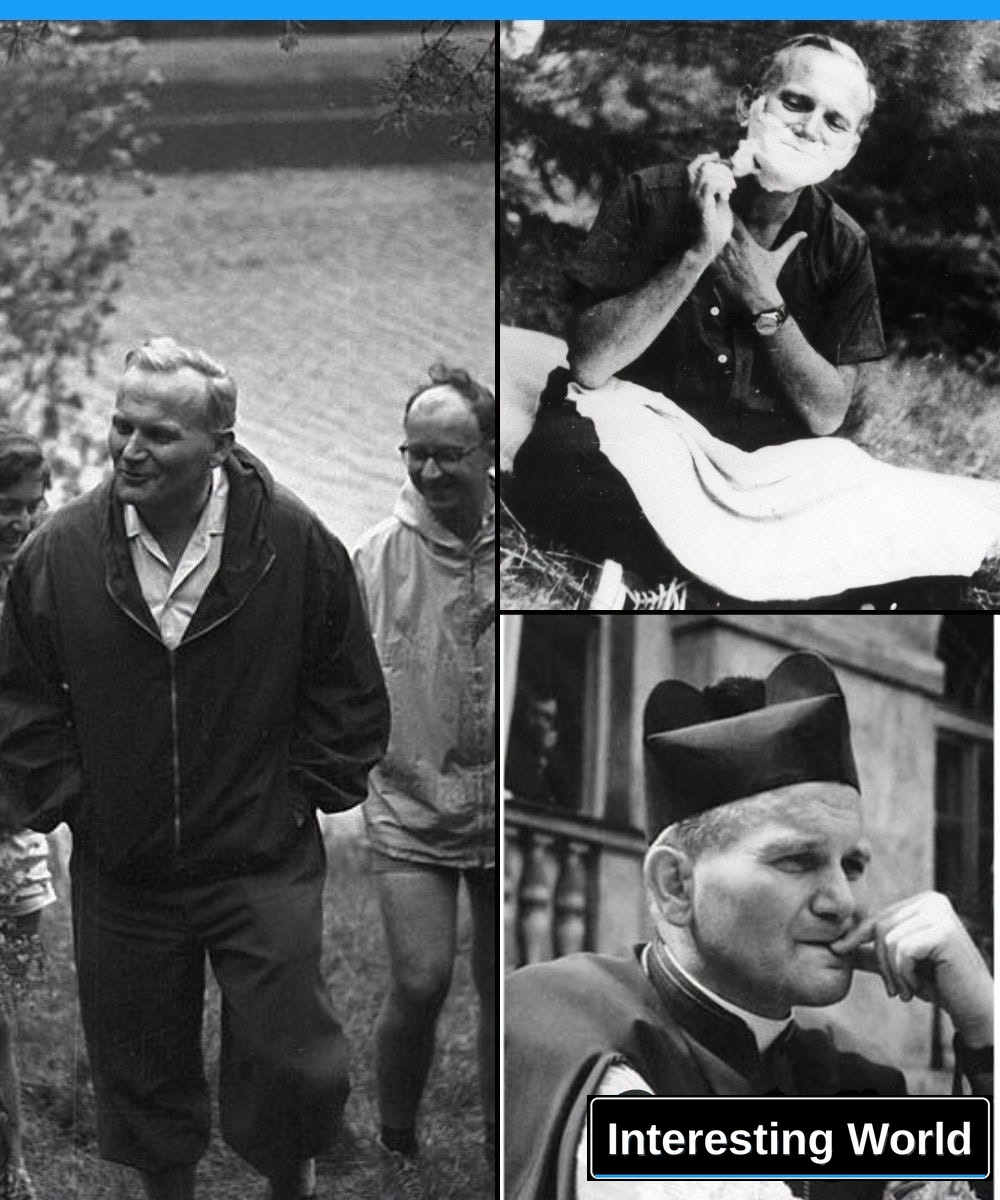
Before becoming one of the most recognizable men of the twentieth century, Karol Wojtyła had been a boy who, at twenty years, no longer had any member of his closest family.
Born in Wadowice, Poland, he suffered mourning very soon. He lost his mother in 1929, when he was not yet nine, his older brother a few years later and finally his father in 1941.
But just as his family life broke permanently, his country was also crossing one of the most dramatic pages of his history.
Poland was under Nazi occupation.
The young Karol first worked in a quarry and then in the chemical plant Solvay, works that allowed him to avoid deportation to forced labor in Germany. In the meantime, a choice destined to completely change its existence: to become a priest.
But he could not study freely.
Theological formation occurred clandestinely, in the secret seminary organized in Krakow during the occupation, at a time when Polish priests, intellectuals and opponents were continually exposed to Nazi repression.
Karol survived the war.
Then a journey began that, many years later, would take him far from that devastated Poland.
On 16 October 1978 it appeared from the central loggia of St. Peter's Basilica with a new name: John Paul II.
The election had a huge historical significance.
He was the first Polish pope and the first non-Italian pope after over four centuries.
But one of the characteristics that would most define his pontificate was the direct relationship with the world.
John Paul II transformed the apostolic journey into one of the central instruments of his ministry. He crossed continents, met communities far from Rome and made 104 international apostolic journeys, visiting 129 countries and personally reaching millions of people.
Then, on May 13, 1981, his life threatened to interrupt in St. Peter's Square.
Mehmet Ali Ağca shot him while the Pope crossed the square. John Paul II was severely affected and subjected to long surgery.
He survived.
But the most surprising chapter of that story came two years later.
On 27 December 1983 John Paul II entered the Roman prison of Rebibbia to meet the man who tried to assassinate him.
The two spoke personally.
The Pope had already stated that he had forgiven him and that encounter turned that forgiveness from abstract concept into concrete gesture: victim and attacker sitting in front of each other.
John Paul II kept the most personal content of their conversation.
In the following years he would face another battle, this time without a visible enemy.
Parkinson's disease, along with other health problems affecting him in recent years, progressively made his movements and speech more difficult. Yet Wojtyła continued to appear publicly even when his body clearly showed fatigue.
It was an unusual image for a figure of such importance: fragility was not hidden.
When he died in the Vatican on 2 April 2005, a pontificate lasted more than twenty-six years.
On the days of the funeral, from St. Peter's Square a cry was raised to become famous: “Holy now.”
The canonical path came to its completion on 27 April 2014, when John Paul II was proclaimed holy by Pope Francis.
His life had begun in a small Polish city, had passed through family mourning, Nazi occupation, workers' work, clandestine priestly formation, an attack and a long illness.
Maybe that's what makes Karol Wojtyła's story bigger than the role he would play.
Before the white robe, travel and crowds, there was a young man who had seen almost everything he knew disappear.
And he kept walking.

Before becoming one of the most recognizable men of the twentieth century, Karol Wojtyła had been a boy who, at twenty y
Category: Life Stories