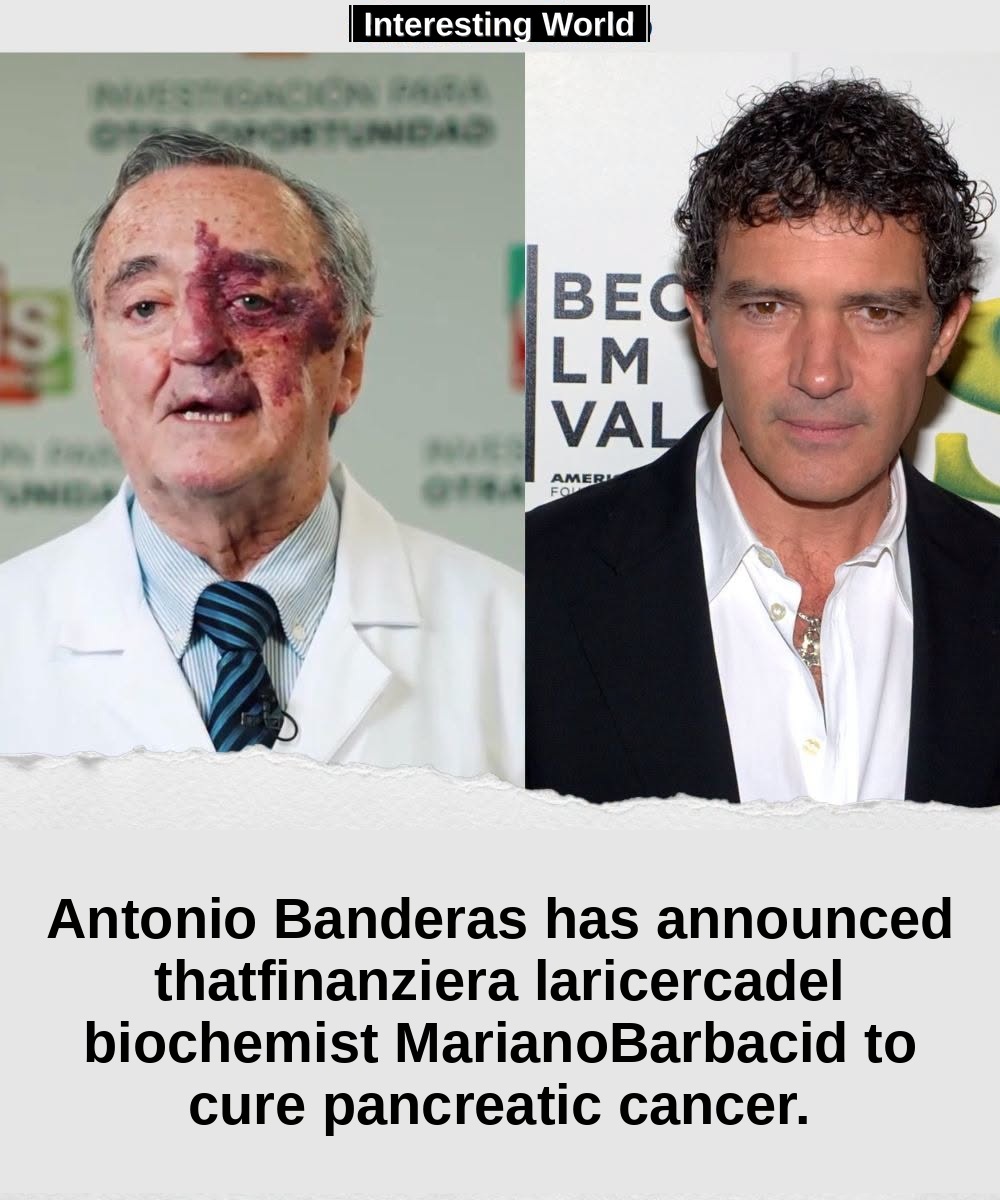
Antonio Banderas has decided to put his notoriety at the service of a battle that is fought especially in the laboratories.
In February 2026 the Spanish actor announced its support for research on the tumor of the pancreas led by the scientist Mariano Barbacid, explaining that the Fundación Lágrimas y Favores, chaired by him, would provide its economic contribution to the project.
It is a gesture that goes beyond simple solidarity.
Financing research means offering scientific groups more resources to continue studying the mechanisms of the disease, experimenting new strategies and seeking more effective treatments.
Barbacid is a reference figure of Spanish and international cancer research and his work has been focusing on the molecular mechanisms involved in cancer development for decades.
The group he directed to the CNIO has obtained promising results against the tumor of the pancreas in experimental models murine. It is not a question of a therapy already demonstrated in man.
The pancreatic tumor is a particularly complex challenge because it can be diagnosed when it is already in an advanced stage and therapeutic possibilities are more limited.
For this reason, every progress arises from a path that rarely produces immediate results: years of experiments, tests, attempts and studies before a discovery may eventually result in a benefit for patients.
The scientific event also had an important development: the original article of the group was withdrawn by PNAS for a significant conflict of interest not declared by the authors at the time of the presentation. A new version of the study was subsequently published with some changes and with the declaration of conflicts of interest. Retreatment, therefore, is not equivalent to showing that experiments were false, but it is a necessary element to correctly tell the story.
And this is perhaps the most significant aspect of Banderas' choice.
A donation is not equivalent to the discovery of a new cure and does not guarantee that a particular research will lead to a new treatment.
However, it can allow the search to continue.
When a famous person decides to concretely support a scientific project, he also does not bring only economic resources. It can draw attention to diseases for which science still needs time, investments and new knowledge.
Because behind every possible therapy of the future there is almost always something much less visible than a great announcement: researchers who continue to work when there is still no definitive answer.

Antonio Banderas has decided to put his notoriety at the service of a battle that is fought especially in the laboratori
Category: Life Stories