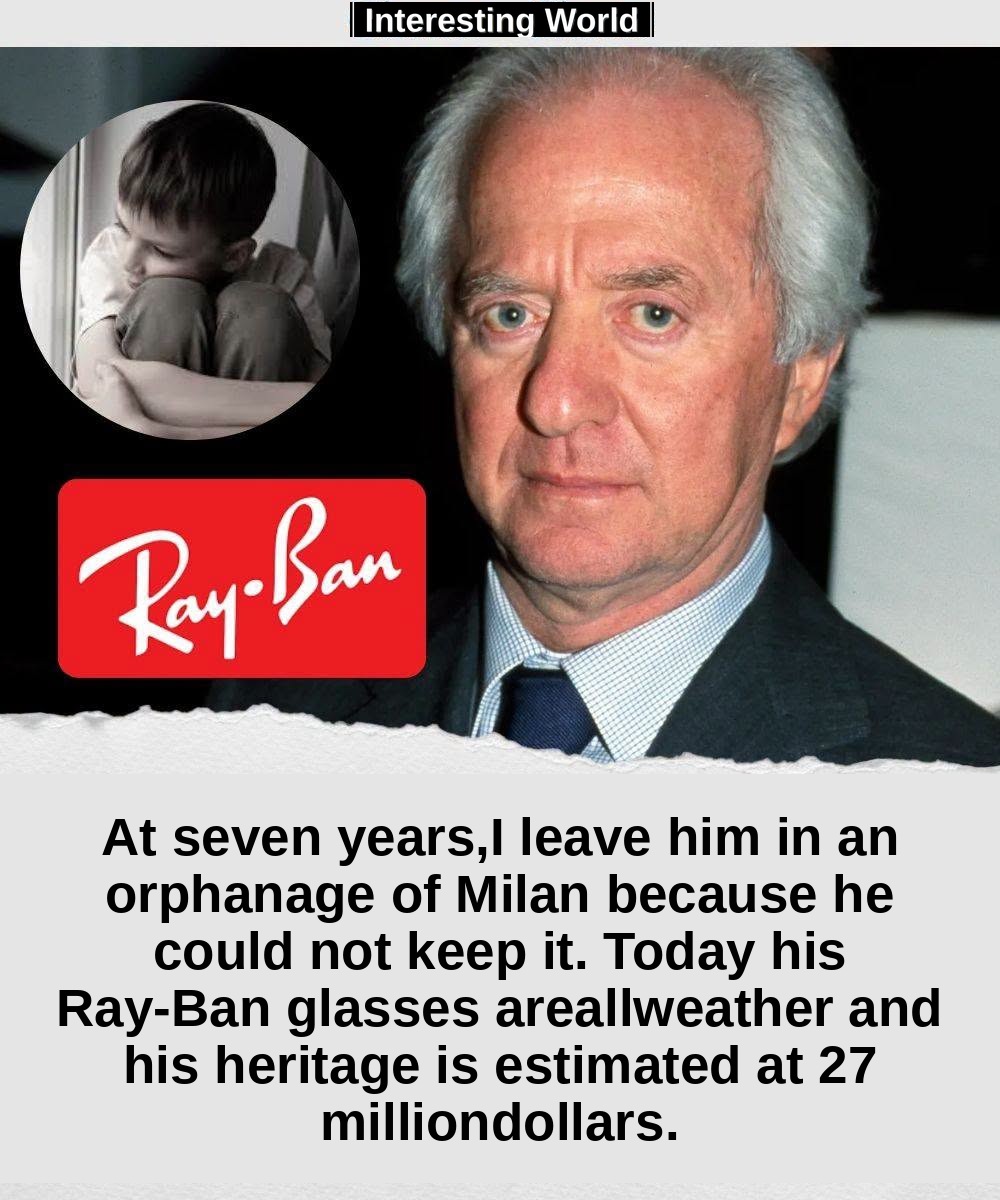
Before becoming one of the richest men in Italy, Leonardo Del Vecchio experienced a childhood marked by poverty.
He was born in Milan in 1935. He remained without a father and grew up in a family with very limited resources, at about seven years he was entrusted by his mother to the Martinitt, the historic Milanese institute that welcomed children in difficulty.
Del Vecchio spent most of his childhood, where he remained until the middle license.
Still a teenager began working as an apprentice. One of his first work experiences was Johnson, a Milanese company that produced cups and medals.
She worked the day. In the evening he attended drawing and engraving courses, aging technical skills that would become important for his future.
Then came the choice that changed everything.
In 1961 he moved to Agordo, Bellunese, where he founded Luxottica. At first the company was a small workshop that made moulds, metal and semi-finished parts for other eyewear companies.
Later Del Vecchio decided to control an ever wider part of the production, until it reached the production of the complete eyewear. In 1971 Luxottica presented his first collection of eyeglasses at MIDO in Milan.
From that small centre of the Dolomites began an expansion destined to bring the group far beyond the Italian borders.
Over the decades, Luxottica read its name worldwide, including Ray-Ban, Oakley and Sunglass Hut. In 2018, the union with the French Essilor, from which EssilorLuxottica was born, one of the world’s leading eyewear and lens groups.
Del Vecchio died in 2022, at 87, after building an estimated assets of around $25 billion.
But the most surprising part of its history remains perhaps the distance between the starting point and the arrival point.
A child entrusted to an institution because the family did not have the necessary resources to maintain it became man in the lead of an enterprise capable of bringing his glasses and his brands around the world.
His story does not erase the hardness of that childhood. It shows, however, how technical skills, study and an extraordinary attention to production can become, over a lifetime, the foundations of an industrial empire.

Before becoming one of the richest men in Italy, Leonardo Del Vecchio experienced a childhood marked by poverty.
Category: Life Stories