
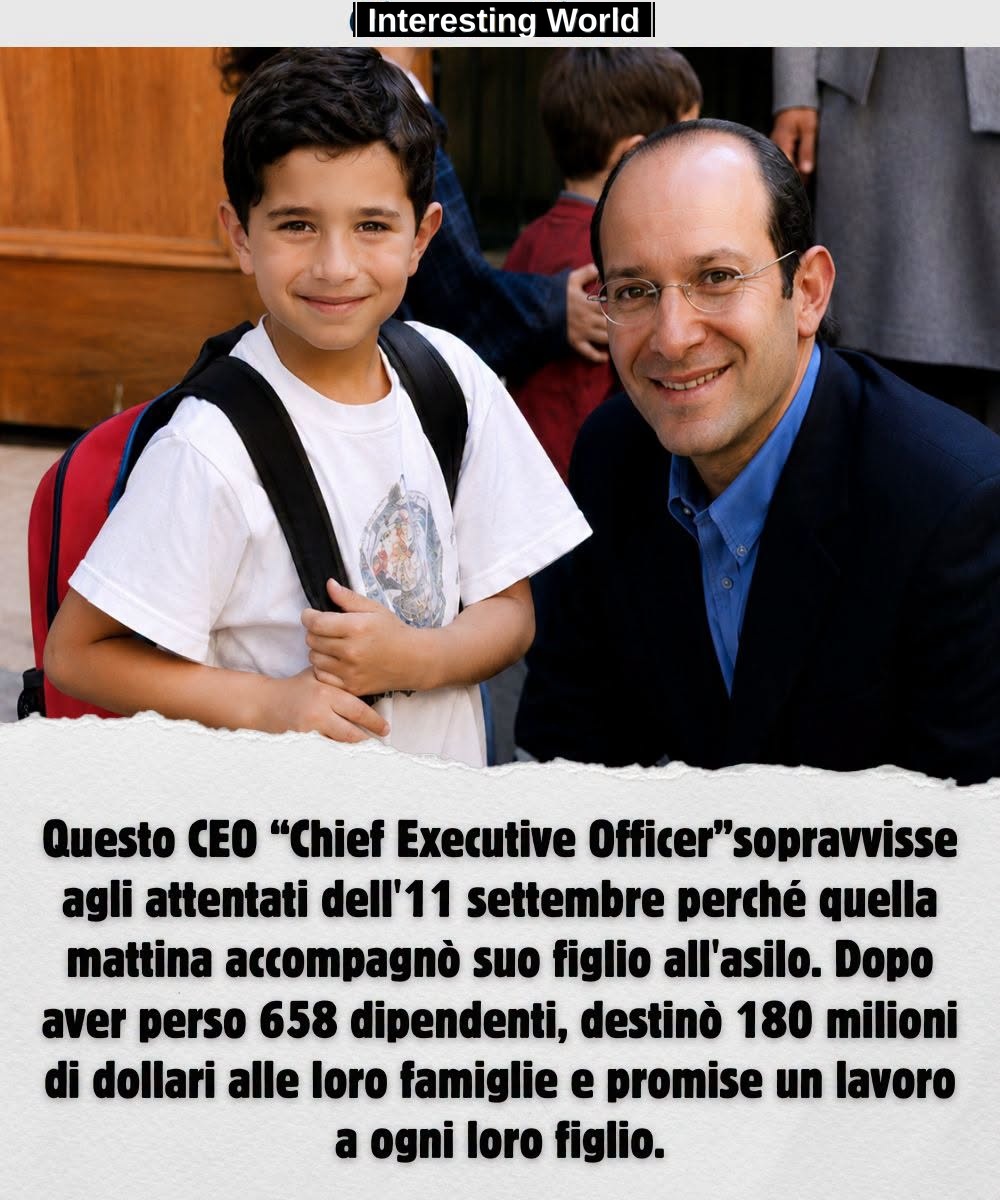
On the morning of 11 September 2001 he arrived at the office later than expected. That little delay saved his life.
Howard Lutnick, managing director of the financial company Cantor Fitzgerald, had made a decision that many parents take at least once in their lives: to accompany their son Kyle on his first day of kindergarten.
For this reason he had not yet arrived in his office when the planes hit the Twin Towers.
The Cantor Fitzgerald headquarters occupied the plans from 101 to 105 of the World Trade Center North Tower.
Almost no one managed to save himself.
For Howard the tragedy was not only that lived by an entire nation. It became a personal and immense pain.
658 employees of the company lost their lives, the highest number recorded by a single company in the September 11 attacks. His younger brother Gary and his best friend, Douglas Gardner.
In the face of such a devastating loss he could only think of saving his own company.
He chose instead to think of the families left without a father, mother, son or daughter.
He made a promise.
For the next five years, 25% of Cantor Fitzgerald's profits would be destined for the families of the dead employees in the attacks. The company also granted ten years of health coverage to their family members.
Overall, over 180 million dollars were distributed to help them face the consequences of that tragedy.
But Howard also wanted to do something to look at the future.
He promised that every son of a Cantor Fitzgerald employee who died in the September 11 attacks would have had the opportunity to work in the company once he reached the appropriate age.
By 2016, 57 of those boys and girls had joined the company.
In the following years Cantor Fitzgerald continued to recall the victims through Charity Day, an annual day dedicated to fundraising for beneficial initiatives that allowed millions of dollars to be allocated to solidarity.
Howard Lutnick has never been able to erase the pain of that day.
He chose to transform a personal tragedy into a concrete commitment to those who had remained.
Because sometimes the most authentic way of honoring those who are no longer there is not just remembering it, but continuing to take care of the people he left.