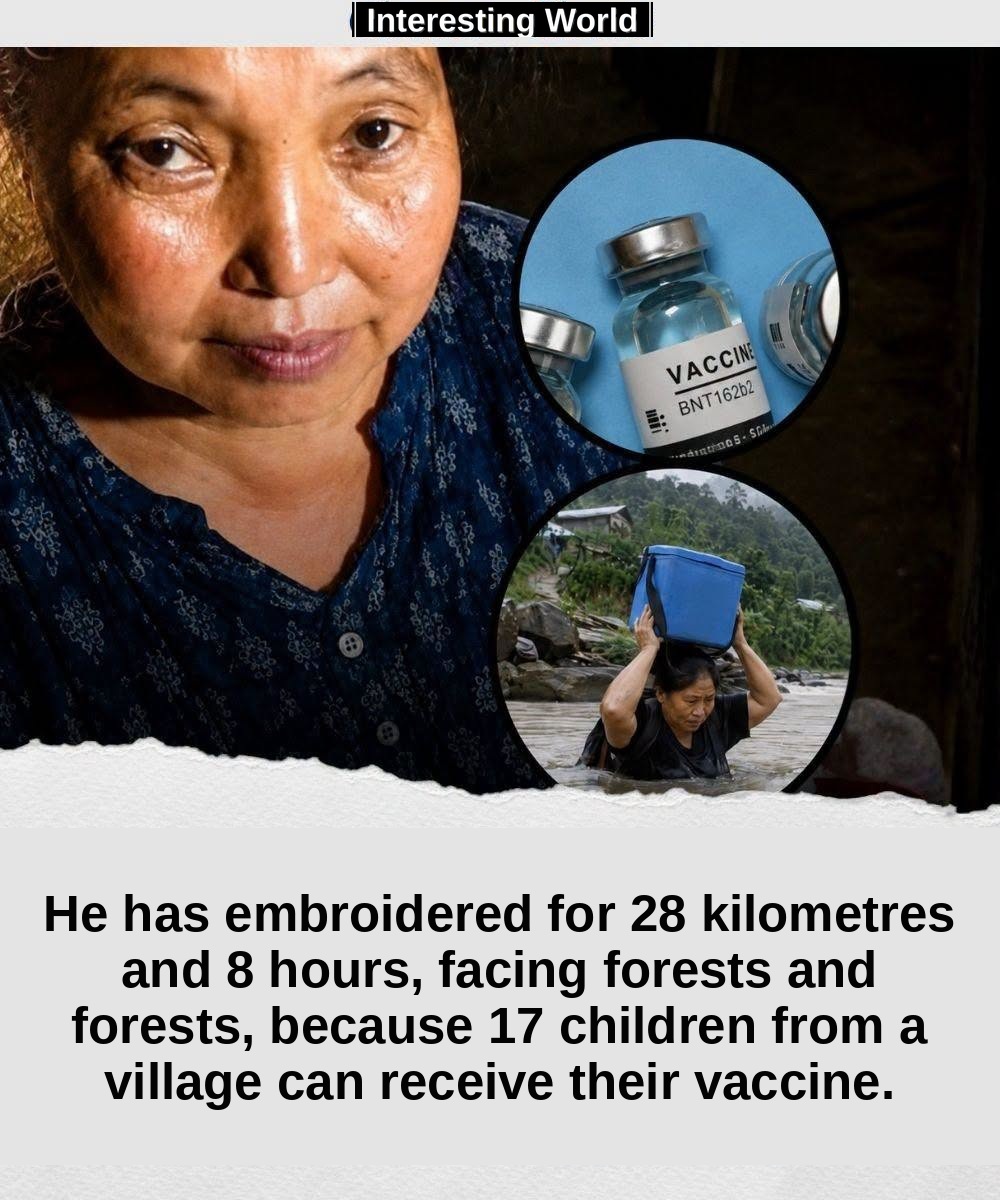
To reach those 17 children there were no roads. So Meidinliu Newmai took their doses of polio vaccine and began walking.
Twenty-eight miles. Eight hours of travel. Planted forests, rough terrain and five rivers to cross on foot.
In October 2025, this 50-year-old community health worker had to reach Nenloung Atangkhullen, an isolated village in the Tamenglong district, in the Indian state of Manipur.
The destination was not connected by roads.
But in the village there were 17 children who had to receive the drops of the oral vaccine against polio in the intensified campaign of immunization of India.
And those doses had to get to them.
Throughout the course, Meidinliu brought a refrigerated container, necessary to keep the vaccines at the expected temperature and preserve its effectiveness.
Every kilometer, therefore, had a precise responsibility: it was not enough to arrive. It was necessary to arrive while maintaining the doses at the correct temperature.
After eight hours of walking, he reached the village.
All 17 children could be vaccinated.
For Meidinliu, however, reaching communities far from normal health services is not an isolated gesture.
He works as ASHA, a community health worker, since 2007. For almost twenty years it has been a concrete link between the health system and the populations scattered in areas where even reaching a clinic can become complicated.
His work includes vaccinations, health education, maternity care and first aid.
It is easy to think about health as hospitals, ambulances, laboratories and large structures.
In some places, however, it can have the face of a woman carrying a small refrigerated bag through a forest and crosses five rivers on foot.
Because a vaccination campaign can be organized on a national scale, but its effectiveness is also decided in the last section: what separates a dose from the child who must receive it.
In Nenloung Atangkhullen, that stretch was 28 kilometers long.
Meidinliu Newmai walked him.

To reach those 17 children there were no roads. So Meidinliu Newmai took their doses of polio vaccine and began walking.
Category: Life Stories