For thousands of people, Dr. Sanduk Ruit is the man who helped to return their sight after years in blindness.
Its history begins very far from modern operating rooms.
Ruit grew up in a small isolated village in the mountains of Nepal, in a place where access to doctors and hospitals was extremely difficult.
The disease soon entered his life.
After losing a sister because of tuberculosis, a curable illness, he decided to study medicine. That experience helped direct a choice that, many years later, would change the lives of hundreds of thousands of people.
Become an ophthalmologist, Ruit found himself in front of a paradox.
In rural areas he met people who had lost sight because of the cataract. It was not necessarily an irreversible condemnation: the view could be recovered with surgery.
The problem was getting to that surgery.
For many farmers and families with very few resources, the costs and distance from health facilities made it possible to care practically unreachable.
Ruit then helped develop a system capable of making cataract surgery faster and more accessible, using intraocular lenses produced at much lower costs.
In some cases the operation can take just a few minutes.
But the most important part of his work was to take care where the patients were.
Mobile clinics and temporary facilities allowed the teams to reach remote communities in the Himalayas and later people in other developing countries.
The result is measured in something larger than a number.
In the course of his activity, Ruit's work helped to return the view to hundreds of thousands of people.
Behind that figure there are men and women who could once again recognize the face of their children, move without constantly depending on others and, in many cases, return to work.
This is the deepest meaning of its history.
Ruit did not just ask himself how to cure the cataract.
It is asked how to make that cure accessible to a poor person, far from a hospital and without the possibility to pay an expensive intervention.
Because a cure can exist for years.
But for those who cannot reach it, it is almost as if it did not exist.

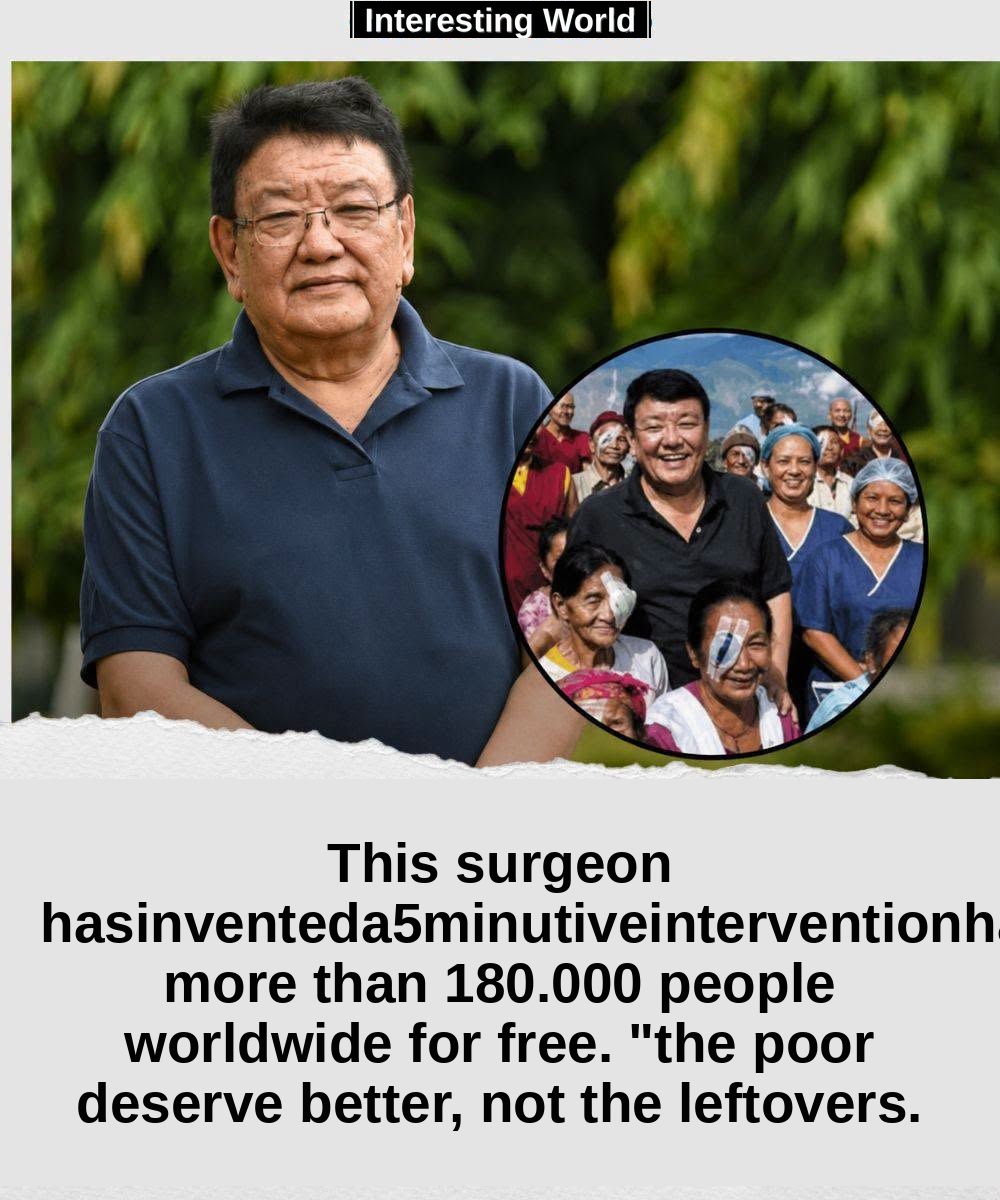
For thousands of people, Dr. Sanduk Ruit is the man who helped to return their sight after years in blindness.
Category: Life Stories