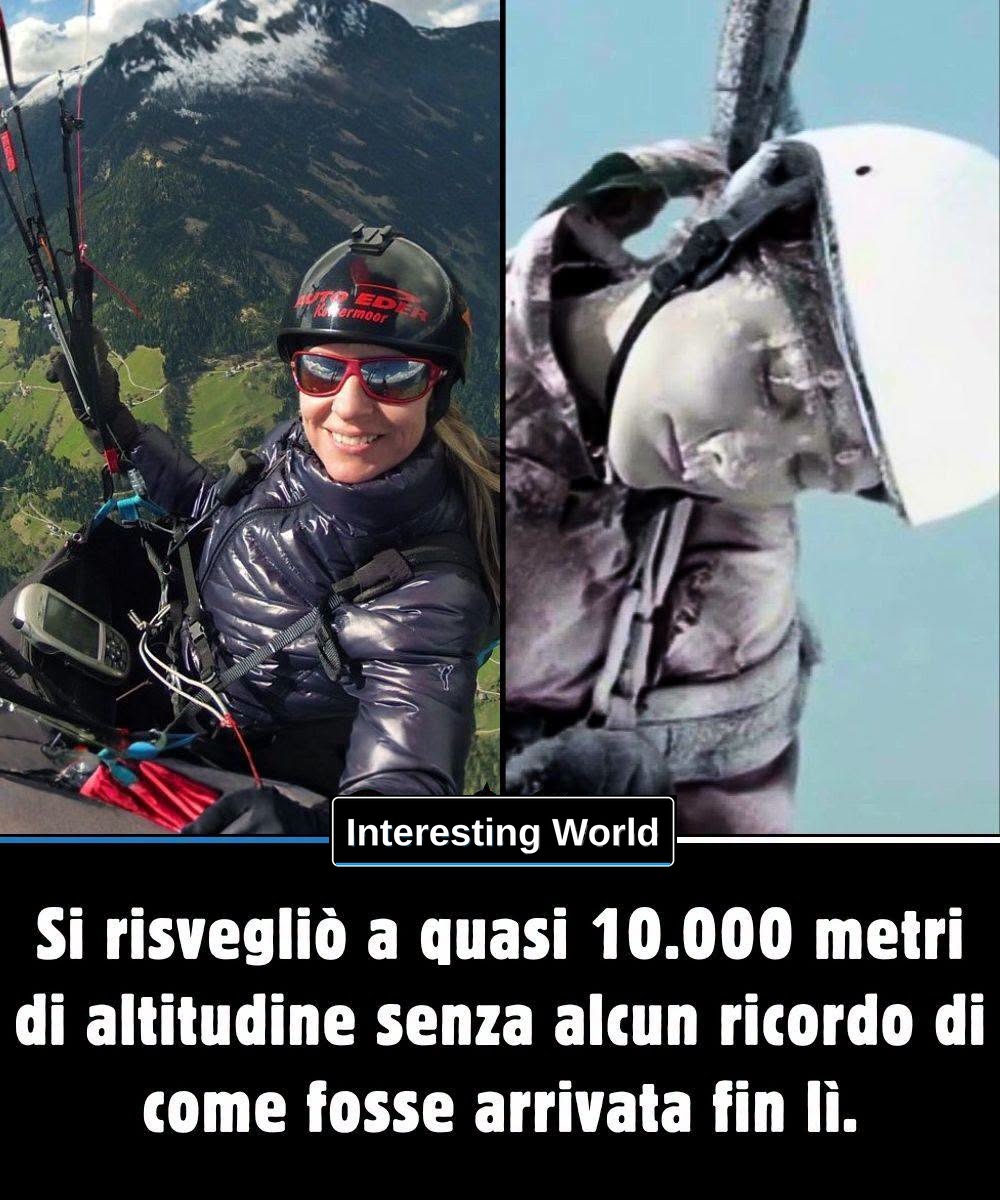
When he opened his eyes, he was flying at almost 7,000 meters. She didn't remember how she got up there. And the GPS would have revealed you an even more incredible truth.
On February 14, 2007, Ewa Wiśnierska, a paragliding driver born in Poland and competing for Germany, was training near Manilla, New South Wales, Australia, in view of the World Championships.
He was ten years of experience and he knew the risks of flying well.
That day, however, the sky changed faster than expected.
In the distance they were forming massive temporal clouds. Ewa thought he could avoid them, but in a few minutes a violent ascensional current sucked it into a gigantic heap.
Reached 4,000 meters, he still managed to contact via radio the manager of the German team.
He said it was raining, that it was starting to snow and that it continued to climb without any chance to stop.
Then every contact broke out.
Within the cloud there were no more horizon or light. The lightning illuminated for an instant the dark, the ice accumulated on the equipment and the paragliding was hit by violent turbulence.
At about 6,900 meters his body could no longer endure the scarcity of oxygen.
He lost consciousness.
But the flight continued.
The GPS, which remained on, recorded every moment.
When the data was analyzed, something impressive emerged: the paraglider had reached 9,946 meters of altitude, over a kilometre above the summit of Everest and at odds normally reserved to airliners.
Up there the temperature touched the 50 degrees below zero and the air was too rarefied to allow a person to remain conscious without additional oxygen.
Ewa remained unconscious for about forty minutes.
When he opened his eyes he was again around 6,900 meters.
He had the face covered with ice, the frozen equipment and for some moments he could not even find the controls of the paraglider.
The storm hadn't let her go yet.
With great clarity he managed to regain control of the wing, now weighed down by water and ice, starting a long and delicate descent.
Hours later I will land in a rural area, about 65 kilometers from the take-off point.
He had the frozen face and ears, numerous bruises and the body tried by the prolonged lack of oxygen.
According to one of the doctors who visited her later, loss of consciousness could have temporarily reduced the oxygen consumption of her organism, increasing the chances of survival. A plausible hypothesis, but unable to fully explain how she managed to save herself.
That day entered the history of paragliding.
Not only for the exceptional altitude reached, but because it showed how subtle the boundary between life and death could be when the force of nature takes control.
For almost an hour, Ewa couldn't decide anything.
And yet he returned to the ground.
A survival that is still remembered today as one of the most extraordinary ever documented in the free flight.
Small Stories

When he opened his eyes, he was flying at almost 7,000 meters. She didn't remember how she got up there. And the GPS wou
Category: Life Stories