A photograph that many considered too controversial ended up returning the smile to a child.
In 1958, the Catalan photographer Ricard Terré was in Sant Boi de Llobregat to document the Corpus Domini celebrations. Among the girls dressed for the First Communion, one immediately captured his gaze.
Her name was Isabel Clemente.
While the others were portrayed of shoulders, she looked straight towards the goal. He wore his white dress and squeezed a small bouquet of flowers with stems wrapped in tin paper. His strangeness was evident, but Terré did not try to highlight that condition. He simply saw a child, with all the spontaneity and innocence of that special day.
When he decided to exhibit that photograph, in 1959, at the Sala Aixelà in Barcelona together with Xavier Miserachs and Ramón Masats, he received more than one criticism.
Some colleagues suggested he withdraw it, convinced that the public would interpret that image as a form of exploitation of the child's condition.
Terré did not change his mind.
And it was precisely that decision to give the photograph a completely unexpected destiny.
During the exhibition, a doctor, Dr. Pascual, was deeply impressed by the shot. He asked Terré what he would ask to photograph the First Communion of his son.
The photographer's answer surprises him.
He didn't ask for money.
He asked that the intervention should be paid in the eyes of the child portrayed in photography.
The doctor accepted without hesitation and committed himself to engaging one of Barcelona's best known ophthalmologist surgeons.
But there was no obstacle: no one knew the identity of the child.
Terré died numerous copies of the photograph and began to distribute it in Sant Boi de Llobregat schools. After several researches, someone recognized her. Isabel belonged to a family originally from Extremadura moved to Catalonia.
Parents were tracked and contacted with doctors.
The agreement was respected.
Terré photographed the communion of Dr. Pascual's son-in-law and Isabel was able to take part.
A few months later, the photographer received a visit he would never forget.
Isabel showed up with her parents. He still wore the dress of the First Communion. This time his eyes were perfectly aligned. To thank him, they gave him a live chicken, a simple but deeply sincere gesture.
He understood that he was in front of an unrepeatable moment.
Yet he chose not to photograph it.
Years later he explained that some images deserve to remain only in memory. He made only a small portrait of Isabel's face, convinced that that moment belonged first of all to their humanity and only after photography.
Today, the scene of 1958 is considered one of the masterpieces of Ricard Terré.
But its deepest meaning goes beyond artistic value.
It shows that sometimes a photograph is not limited to stopping time. It can change the course of a lifetime.

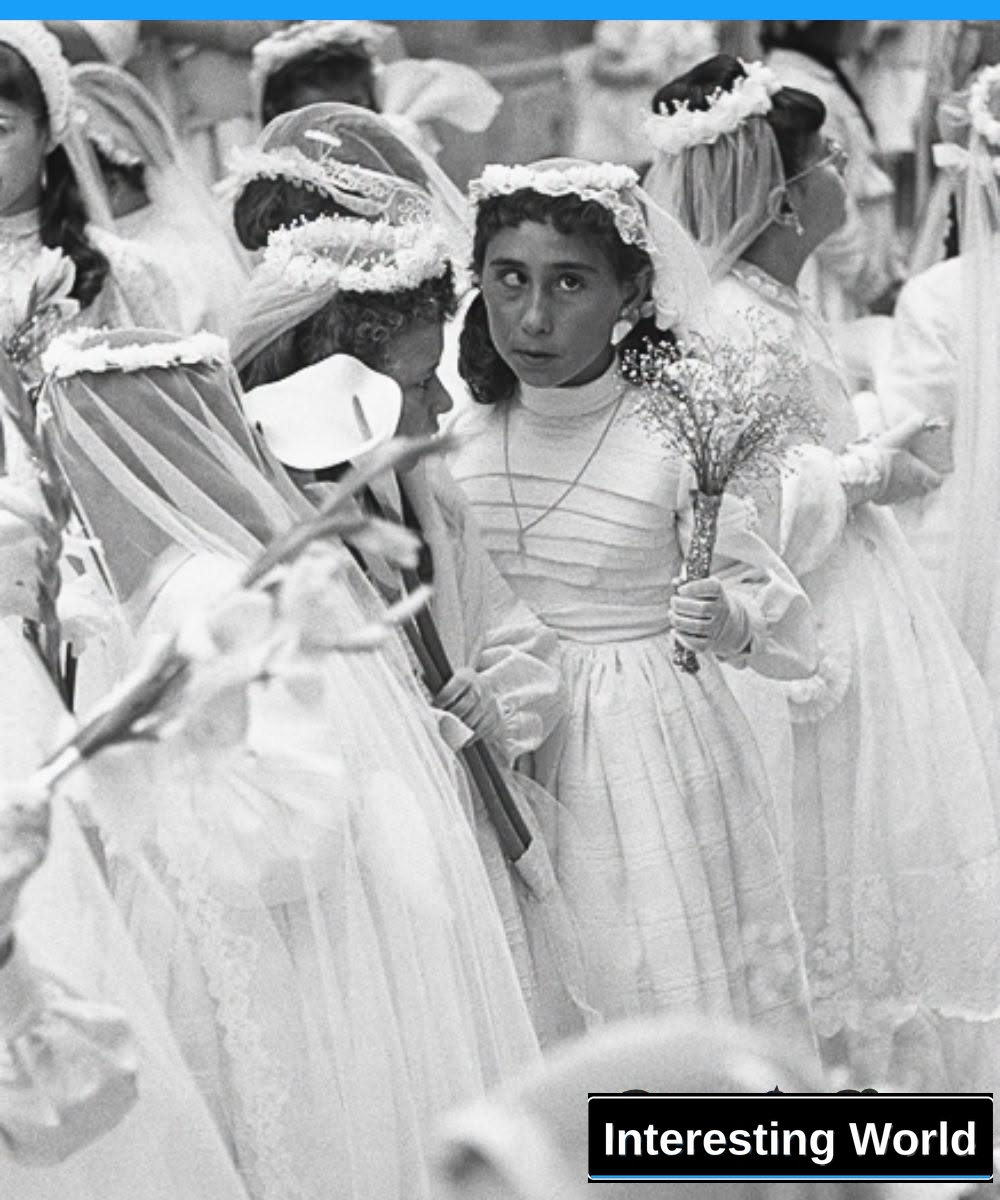
A photograph that many considered too controversial ended up returning the smile to a child.
Category: Life Stories